
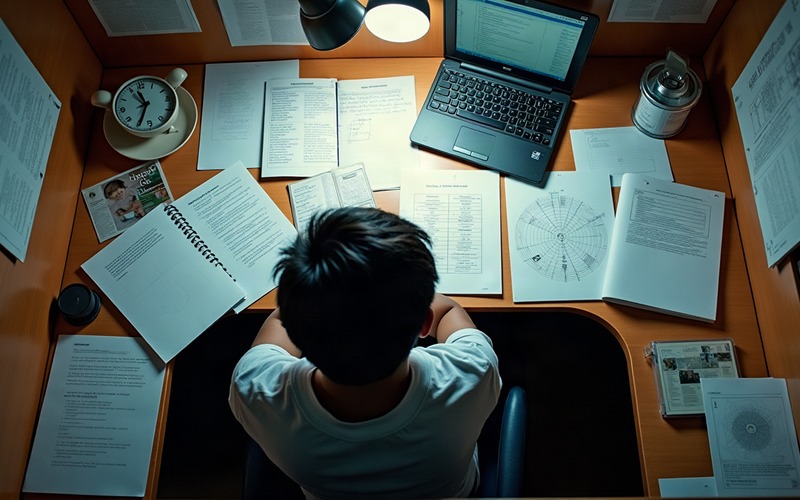
Where Revision Plans Quietly Go Wrong
Most Secondary 4 students preparing for O-Level Combined Science aren’t short on effort. They put in the hours, attempt practice papers, and revise notes repeatedly, yet scores often plateau well before the actual examination. The problem usually isn’t a lack of commitment but a handful of habits that quietly undermine an otherwise solid study routine. Recognising these mistakes early leaves enough time to correct the course before the exam timetable closes that window.
1. Treating Combined Science as Two Separate Subjects Instead of One Integrated Paper
Combined Science students often study Physics and Chemistry, or Chemistry and Biology, as though they were entirely independent subjects revised in isolation. In reality, the O-Level paper structure sometimes tests how well a student can apply reasoning across both components within a single question. Students who never practise this crossover struggle when a question unexpectedly blends concepts from both subjects, even if they understand each half perfectly on its own. Secondary science tuition in Singapore often has to correct this habit specifically, since it rarely surfaces until a student encounters an integrated question for the first time under exam conditions.
2. Relying Heavily on Notes Instead of Past Year Papers
Rewriting and re-reading notes feels productive, but it doesn’t train the specific skill that the examination actually tests: applying knowledge under timed, unfamiliar conditions. Students who spend the bulk of their revision time on notes rather than past papers often discover, too late, that recognising a concept and applying it under exam pressure are genuinely different skills. Past papers reveal question patterns and phrasing that notes alone never expose.
3. Ignoring the Specific Requirements of Combined Science O-Level Marking
Combined science O-Level tuition in Singapore frequently has to address a persistent misconception that marking standards mirror Secondary 1 or 2 expectations. In practice, O-Level markers expect precise terminology, clear causal links, and answers structured to match the number of marks allocated. A student who continues writing answers the way they did two years earlier often loses marks not from incorrect understanding, but from a mismatch between their answering style and what O-Level scripts specifically reward.
4. Leaving Practical-Based Questions Until the Final Weeks
Practical-based questions, including those testing experimental design and data interpretation, require a different kind of preparation than content recall. Students who delay this section until final revision weeks often find there isn’t enough time left to build genuine comfort with interpreting graphs, identifying variables, and evaluating experimental limitations, skills that improve gradually rather than overnight.
5. Studying All Topics With Equal Intensity Regardless of Personal Weak Areas
Spreading revision time evenly across every topic feels thorough, but it often means strong topics get reinforced repeatedly while genuinely weak ones receive the same limited attention as everything else. A more effective approach identifies which specific topics consistently cost marks and allocates disproportionately more time there, rather than treating the whole syllabus as equally urgent.
6. Avoiding Timed Practice Until Right Before the Exam
Working through questions without a timer builds familiarity with content, but it doesn’t prepare a student for the pressure of completing a full paper within a fixed duration. Students who only attempt timed practice in the final week often discover pacing problems, such as spending too long on early questions, at a point where there’s little time left to adjust.
Quick Checklist Before Exam Season
- Practice papers, not just notes, form the bulk of recent revision sessions
- At least one attempt has been made at a fully timed, complete paper
- Weak topics have been identified specifically, not assumed generally
- Practical-based question types have been practised, not left until later
- Answering style matches O-Level marking expectations rather than earlier secondary habits
What to Adjust With the Time Remaining
None of these six mistakes requires a complete overhaul of an existing revision plan. Most involve shifting emphasis, spending less time on passive review and more on timed, applied practice that mirrors what the actual examination demands. Identifying which of these habits currently applies is usually the clearest starting point for adjusting a revision strategy before the examination date arrives.
Contact Genius Mind Home Tuition to review your child’s current revision approach and identify which O-Level Combined Science topics need focused attention before the exam.


More Stories
The Hidden Tapestry: Unraveling Social Research’s Impact on Daily Life
The Hidden Threads: How Social Sciences Weave the Fabric of Human Connection
The Hidden Stories Behind Social Research: Unveiling the Unseen